Saturday, January 8, 2011

Berthe Morisot's teacher, "Papa" Corot


Corot taught the young Berthe Morisot and in the 1860s introduced her to plein air painting. I have always loved his work, and indeed he greatly influenced the young Berthe's style. He was by that time well into his sixties, a generous man with a mane of gray hair who willingly lent his pupils some of his paintings to take home and copy. Berthe's mother coaxed him into the social circle at her house; he was a shy bachelor and unwilling to come until Madame Morisot agreed to let him smoke his pipe during dessert. They called him "Papa" Corot.

Corot stood strongly behind the young Monet and Pissarro as well. The photograph of him shown was taken by Nadar, who lent his old photography studio at 35 boulevard des Capucines for the first Exhibition of Impressionism in 1874. Corot did not take part in the Exhibition though he had influenced and taught many of its painters.

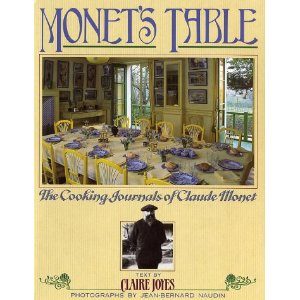
Monet's Christmas lunch


Almost everyone who has journeyed to the master's house in Giverny comes away with a vision not only of the flower gardens but the glorious yellow dining room. We imagine ourselves invited to eat there with the master. Dinner was punctual; Monet would have been up tramping fields to paint since before dawn and was very hungry. He was also very particular. Asparagus was hardly cooked; he covered his salad and much else with almost spoonfuls of black pepper.

In Claire Joyes' fascinating book, Monet's Table, I found some enticing details about Christmas dinner at Giverny. It was served at midday and the dining room was bedecked with garlands of leaves and flowers while table bowls held clusters of Christmas roses and jasmine. Children would find little gray envelopes lined with rose madder at their places containing money from Monet and his wife. There were also mysterious little packets of sweets and small gifts such as pins, medallions and pocket watches. The large presents were waiting under the tree in the dining room.

The meal began with eggs scrambled with truffles or monkfish. Strasbourg truffled foie gras in pastry was served before the truffled, stuffed capon...etc. etc. Lastly there was a lit Christmas pudding and banana ice cream. And to think Monet lived on a sack of beans for a few months in his mid twenties while sharing a studio with Renoir. And they were not truffled beans, I am sure!

(I searched in vain for a Christmas post for this blog and found one two weeks late but here it is! Do get a copy of the book and cook some of the many recipes at the back of it!)

Saturday, November 27, 2010

Van Gogh is a fascinating subject for novelists!


The Van Gogh novels I have read so far are:

LUST FOR LIFE by Irving Stone (1934) which portrays his whole artistic life until his death at 37;
SUNFLOWERS by Sheramy Bundrick (2009), the last few months of his life from the point of view of a prostitute who loved him
THE LAST VAN GOGH by Alison Richman, his doctor's daughter's love for him in the last months of his life;
JOANNA by Clare Cooperstein (1995), about his brother Theo's wife and how she saw the artist;
and LEAVING VAN GOGH by Carol Wallace (2011), his last months from the point of view of his holistic doctor Dr. Gachet

The man is endlessly fascinating! If there are other novels about him, please leave a comment.

where the rejected Parisian painters went in 1863

Oh the scandal! In 1863 Napoleon III instituted a Salon des Refusés where the painters who had been refused a place in the regular annual Salon could hang their work. Taking advantage of this was the young Edouard Manet with his now famous painting Le déjeuner sur l'herbe. The critic Théophile Burger wrote, "I fail to see what could have induced a distinguished and intelligent artist to adopt such an absurd composition."

At the date of this exhibition, Claude Monet was a handsome, dark-haired 23-year-old young recruit in the French army training grounds in Algiers...

Sunday, October 24, 2010

Renoir paints Wagner - from the boating party luncheon to Parsifal

It is rather odd for me to think of Renoir loving Wagner's music though other people may think differently! Renoir was about 42 when he traveled to Palermo to paint the composer who was there finishing Parsifal. Renoir had a rough time. First he could not find Wagner and then he met a young man in Wagner's household who told him the composer was in a state of nerves about finishing his opera (who wouldn't be?) and couldn't be disturbed. After a day or so Renoir did meet the Master who showed up in a velvet dressing gown with wide sleeves lined with satin. In the end the great composer gave the great artist 35 minutes to sketch him! Renoir returned to Paris and made his painting. Wagner was disappointed that Renoir was not Ingres!

Only the year before, the congenial Renoir had painted his delightful Luncheon of the Boating Party.

Thursday, August 26, 2010

New book on Monet's Camille published!


Finally! MONET AND HIS MUSE: CAMILLE MONET IN THE ARTIST's LIFE is available on Amazon. I have been waiting a long time for this critical study by esteemed clinical psychologist and art historian Mary Mathews Gedo. When I began to write my novel I wrote to the foremost American scholar on Monet and I asked, "What can you tell me about Camille?" and he said, "Very little." I am so excited to read this!

From the publisher's description: "And then—Camille. Entering Monet’s life when he was still a young man, becoming first his model and then mistress and then—finally—his wife, Camille Doncieux always fulfilled the function of muse, even after her life had ended, as Monet not only painted her one last time on her deathbed, but preserved her memory through the gardens he planted at his home in Giverny." That was just how I saw it as I wrote, with only scraps of diaries and his portraits of her and a few mentions in their friends' letters to guide me.

Amazon link for the scholarly book is above and here is the link to my novel CLAUDE & CAMILLE: A NOVEL OF MONET for a fictional treatment of this long-lost muse.

Wednesday, August 11, 2010

Berthe Morisot's last letter to her daughter Julie


The beautiful and exquisitely talented Berthe Morisot had already been widowed for some time and was raising her only daughter Julie with the help of friends. Julie was only seventeen when her mother, fatally ill with pneumonia, left her this last heart-rending letter:

"My little Julie, I love you as I die. I will still love you even when I am dead...I had hoped to live until you were married. Work and be good as you have always been; you have not caused me one sorrow in your little life. Do not cry; I love you more than I can tell you...."

115 years after it was written, the love of the great artist for her only child moves me very deeply.